
Something’s been off for a while and you can’t quite put your finger on it. You’re still showing up. Still getting through the job, the errands, the version of the day everyone else sees. But somewhere in there, you stopped feeling like you.
That gap between who you are and how you’ve been moving through life lately is way more common than people admit. It rarely shows up all at once either. It builds slow, through months of stress, a health scare that never got fully processed, a role that quietly ate up everything else you used to be.
The good part is this gap closes. It just helps to know what’s actually behind it first.
What’s Actually Going On Underneath
“I don’t feel like myself” isn’t one thing. A few different causes tend to hide behind that exact sentence:
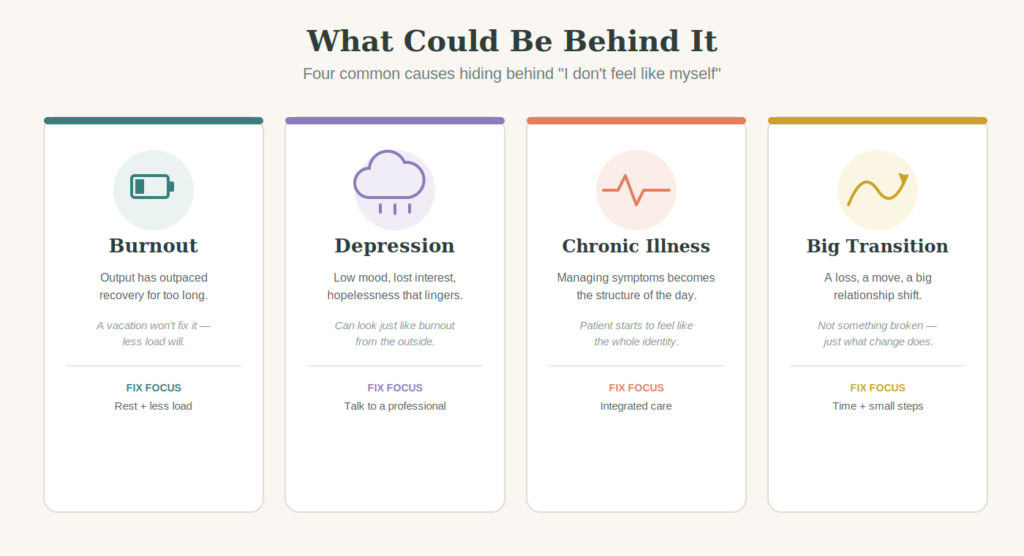
From the outside, depression can wear almost an identical face to burnout. What tends to differentiate it is a low mood that doesn’t get better, lack of interest in things you once found meaningful, and hopelessness. If that resonates, step two is an actual chat with a physician or therapist.
What This Tends to Look Like
A few patterns show up again and again once someone’s lost touch with themselves for a while:
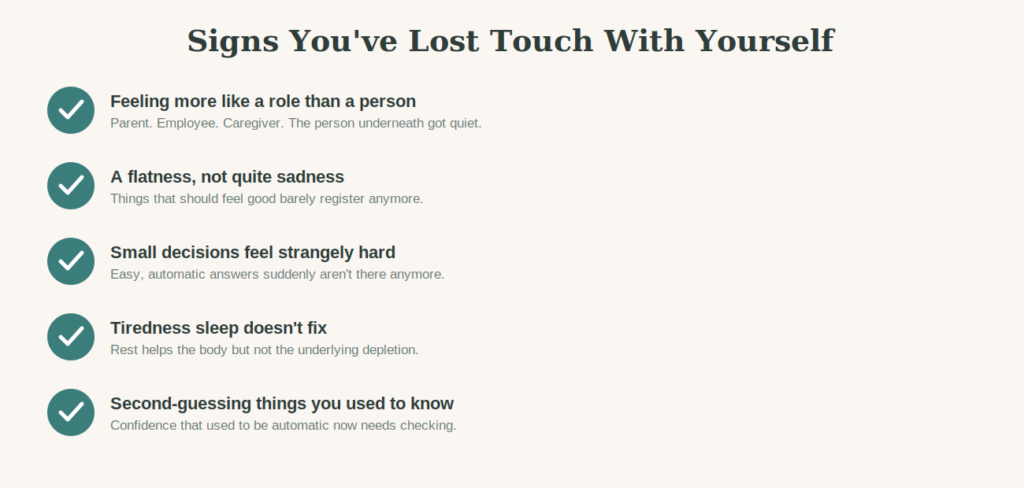
None of that means something’s permanently broken. It usually just means there’s been a long stretch with no room left over to actually be yourself in.
Where to Actually Start
Getting yourself back isn’t one big breakthrough moment. It’s mostly small, repeated choices that slowly open the space back up.
- Notice what’s genuinely yours versus what’s a role you’ve been playing on autopilot.
- Try separating “I have to” from “I want to” for a week — just in your head.
- Bring back one small thing you used to enjoy, even if it feels rusty at first.
- Protect a bit of unstructured time — even fifteen minutes where nothing’s required of you.
- Pay attention to your body, not just your headspace. Sleep and untreated health issues drain the same reserves self-reflection needs.
- Say something to the people close to you, even briefly. Isolation deepens this; connection interrupts it.
When It’s Time to Get Actual Support
Some of this genuinely eases with time, rest, and a few small changes on your own. Some of it doesn’t — and that’s not a failure either.
If the low mood or numbness has sat there for weeks without loosening, or it’s bleeding into work or relationships, that’s worth an actual conversation with someone who does this for a living.
A good provider looks at the whole thing — not symptoms in isolation, but how stress, physical health, and identity are pulling on each other at once.
You Don’t Have to Figure This Out Alone
Feeling like a stranger to yourself for a while doesn’t mean something’s gone permanently missing. It usually just means life asked more of you than it left you room to recover from.
Rayzi Healthcare offers counseling and integrated health support that looks at both the physical and emotional sides of what’s been weighing on you.
If it’s been a while since you felt like yourself, reach out and let’s start finding the way back.


No comment